
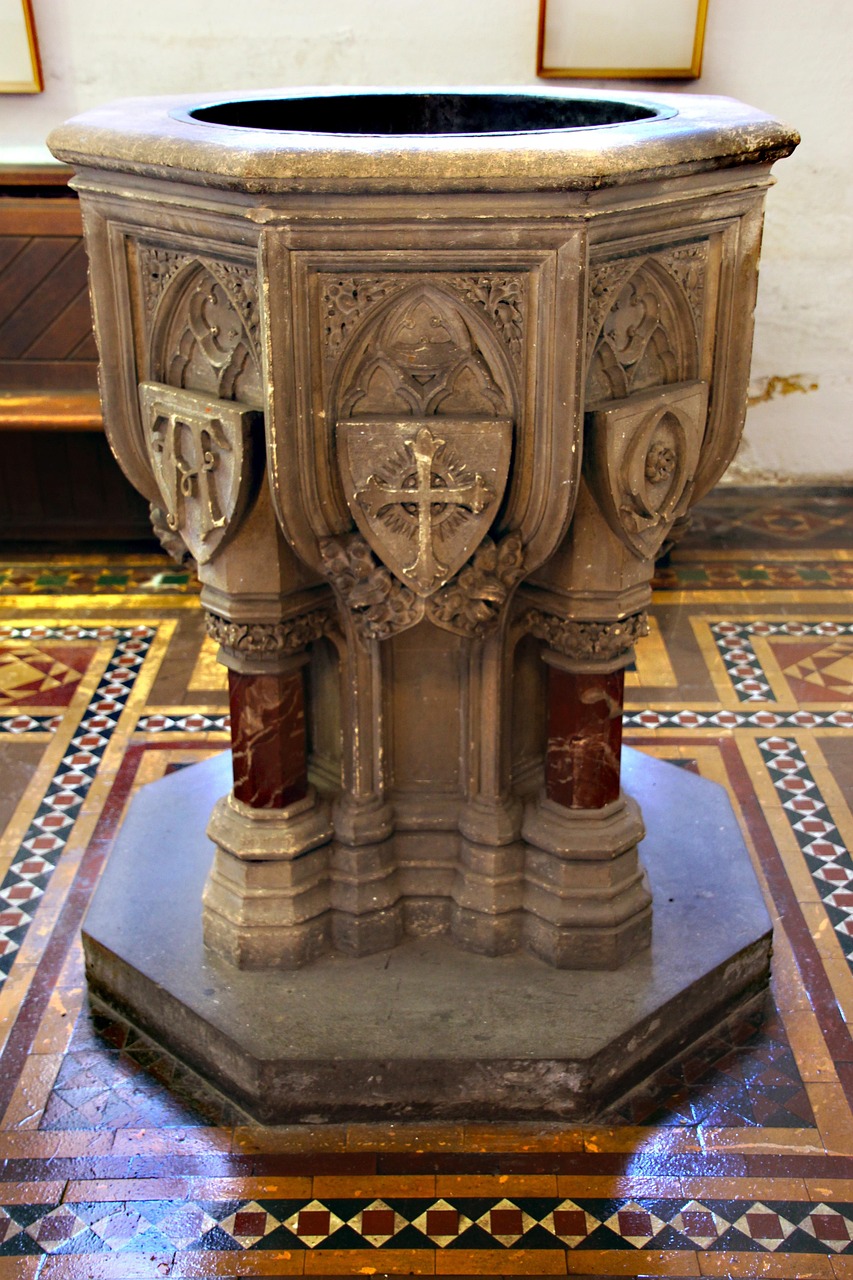
[Guest Post by Nathan Straub; Photo Cred, Dean Moriarty from Pixabay.]
Does baptism save, or does faith save? Good question. Were the citizens of West Berlin saved during the Berlin Airlift of 1948 by food or by the mechanics who fueled up the airplanes that brought the food? Or by the farmers that grew the food? Or by the United States? Yes.
So does baptism save? Yes. Ordinarily. For those who believe.
What is salvation? Salvation is the gift of God coming into our lives and uniting us with Christ and making us whole. It comes on the basis of God’s love poured out in the death of Christ and in Christ’s ongoing intercession for those who belong to him, bringing forgiveness of sins and the life of the coming age.
Salvation is applied to each person by the working of faith in us by the Holy Spirit. We can see it as a point at the beginning of our journey, as a point at the end of time, and a squiggle in the middle.
To be honest, many of us don’t see the point at the beginning, and yet in the midst of the squiggle, we look back and see that we have picked up the clustered elements of conversion along the way, even if through struggle, imperfection, and hardship — or rather, that these have been worked in us by the Spirit’s empowerment and the help and prayers of others, which spurred us on to force our way into the kingdom. These elements include:
- faith (Rom. 5:1)
- repentance (Luke 24:47)
- confession of Jesus as Lord (Rom. 10:9-10)
- baptism (Rom. 6:3-5; Gal. 3:27; 1 Pet. 3:21)
- adoption by God into his global and local family (Gal. 4:5)
- receiving the Holy Spirit (Galatians 4:6)
- obedience to Jesus, his good news, and the truth (Acts 5:32; Rom. 16:26; 2 Thes. 1:8; Heb. 5:9)
- perseverance until the end (Mat. 24:13)
So what is baptism? A visible Word of God — a bodily reminder of the promises of God worked out in the story of Jesus’s death, burial, and resurrection, experienced by being dipped in water and having the name of the Father, Son, and Holy Spirit pronounced over you.
If you receive baptism by faith, then it — like prayer, the Lord’s supper, and the Word — will strengthen your faith so that you continue and grow up into salvation (1 Peter 2:2). The efficient cause of salvation is God and his gift. The means of reception is faith. The instrumental means that the Holy Spirit ordinarily uses to bring about faith and strengthen faith so that we endure to the end and so are finally saved includes baptism.
Now arise some problems:
- Not all who are baptized are saved (because they don’t combine it with faith).
2) Some who are saved aren’t baptized (because God brings about faith in whoever he wants,
even in some who have no opportunity to be baptized).
3) Some have misunderstood, and said that baptism is absolutely necessary for salvation.
Others have misunderstood, and thought that since they were baptized, then they are saved even if they don’t personally know Jesus or follow him.
But on the other hand, there are some who say they believe, and yet have never been baptized because they’re too shy to get up in front of people. This requires serious teaching and personal friendship to help their budding attender’s faith turn into a martyr’s faith.
Lest you think I fell off the deep end, read the following Q&A from the 1693 London Baptist Catechism, which is basically the Westminster Longer Catechism with a credobaptist reform:
#90 What doth God require of us that we may escape his wrath and curse, due to us for sin?
To escape the wrath and curse of God due to us for sin, God requireth of us faith in Jesus Christ, repentance unto life, with the diligent use of all the outward means whereby Christ communicateth to us the benefits of redemption.
#93 What are the outward means whereby Christ communicateth to us the benefits of redemption?
The outward and ordinary means whereby Christ communicateth to us the benefits of redemption are his ordinances, especially the word, baptism, the Lord’s supper, and prayer; all which means are made effectual to the elect for salvation.
#96 How do baptism and the Lord’s supper become effectual means of salvation?
Baptism and the Lord’s supper become effectual means of salvation, not for any virtue in them, or in him that doth administer them, but only by the blessing of Christ, and the working of the Spirit in those that by faith receive them.
#97 What is baptism?
Baptism is an ordinance of the New Testament instituted by Jesus Christ, to be unto the party baptized a sign of his fellowship with him, in his death, burial, and resurrection; of his being ingrafted into him; of remission of sins; and of his giving up himself unto God through Jesus Christ, to live and walk in newness of life.
#98 To whom is baptism to be administered?
Baptism is to be administered to all those who actually profess repentance towards God, faith in and obedience to our Lord Jesus Christ, and to none other.
#99 Are the infants of such as are professing believers to be baptized?
The infants of such as are professing believers are not to be baptized, because there is neither command or example in the holy scriptures, or certain consequence from them to baptize such.
#100 How is Baptism rightly administered?
Baptism is rightly administered by immersion, or dipping the whole body of the party in water, into the name of the Father, and of the Son, and of the Holy Spirit, according to Christ’s institution, and the practice of the apostles, and not by sprinkling or pouring of water, or dipping some part of the body, after the tradition of men.
#101 What is the duty of such who are rightly baptized?
It is the duty of such who are rightly baptized to give up themselves to some particular and orderly church of Jesus Christ, that they may walk in all the commandments and ordinances of the Lord blameless.
About the author
Nathan Straub writes on how historical theology, language, and cross‑cultural perspective shape spiritual formation. He teaches adult ESL at a Portland-area nonprofit, mentors Burmese‑American youth at Oregon Myanmar Christian Church, and helps develop leaders at Intercept, a men’s discipleship ministry. He holds an MA in Linguistics from Payap University and spent 2010–2020 living and researching in Taiwan, Thailand, and Myanmar, with a particular interest in the language, history, and culture of Myanmar’s Rawang people. An amateur fiddler, Nathan brings a love of music and metaphor to his teaching and writing.



 Questions That Matter
Leave a comment