
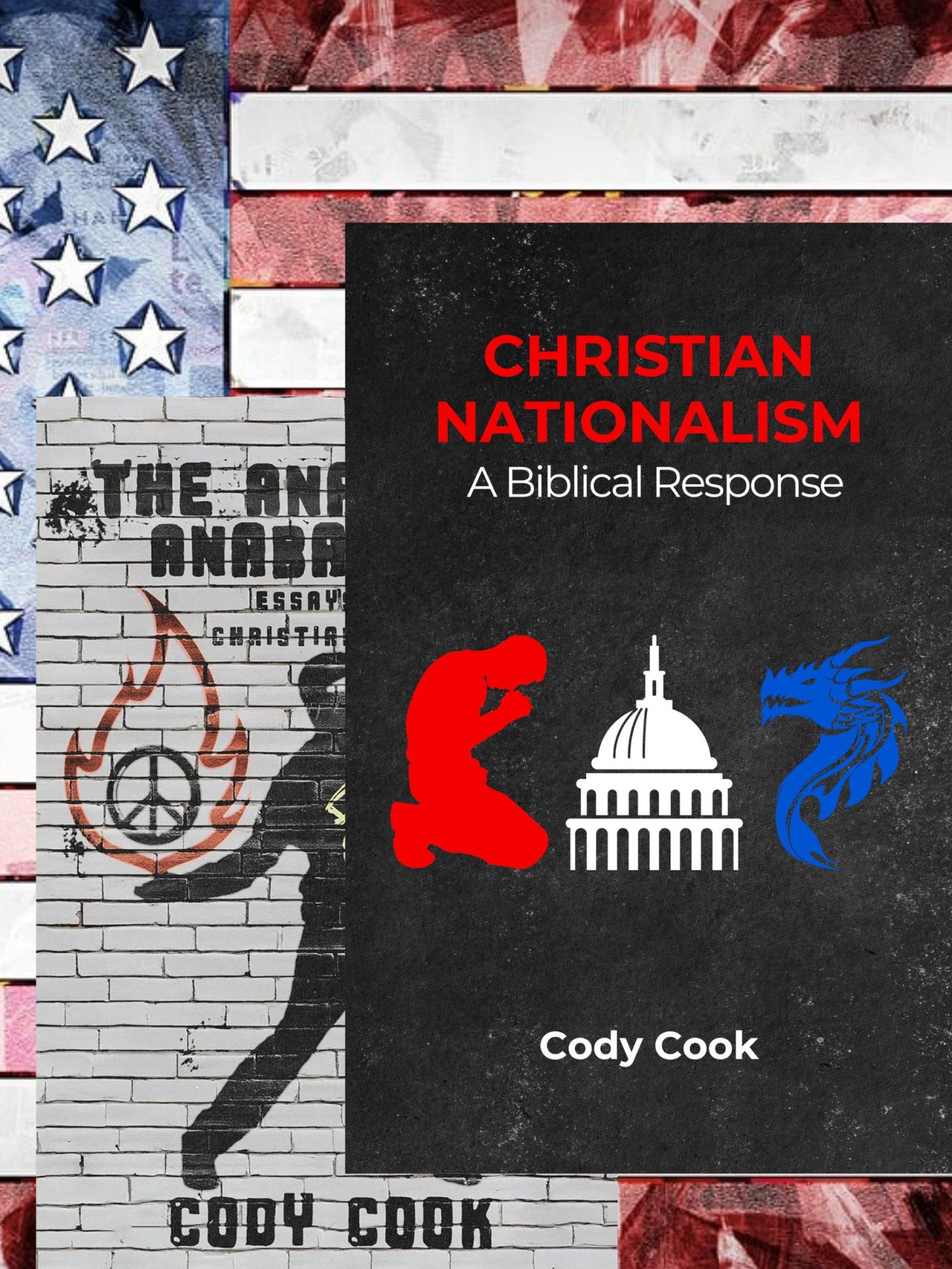
In March of 2025 I sat down with theologian Cody Cook, an intriguing and refreshing voice in American Christianity. We discuss his own political journey, how he took in Trump’s second presidency, and more.
My questions are in bold.
Can you speak into your political journey– where you’ve landed and why?
As a teenage atheist, I had a generally anti-authoritarian disposition. But becoming a Christian and studying Scripture formally helped me develop a more Christocentric political posture and zero in on the political issues that are most relevant to a Christian political philosophy. Early Anabaptism and the modern libertarian movement also played a part.
So at this point, I’d call myself a libertarian Christian or Christian anarchist. There are two major components to this philosophy for me:
- The Non-Aggression Principle. This is the center of libertarian philosophy, and it posits that the initiation of force against peaceful people is wrong. If this dictum is true, then government should only use violence against the violent–which means things like offensive wars, taxation, redistribution, and the war on drugs are immoral and illegitimate.
- The kingship of Christ. Christians are called to full allegiance to Jesus and to separate from the idolatry of political power and its violence. For Christians, this partly entails pacifism.
The early Anabaptists held these two biblical touchpoints in tension–they recognized a limited role for government, but they also largely kept separate from its functions. This is also how I try to approach my political philosophy as a Christian.
When it comes to what has been taking place with the Trump administration these last few months, some Christians are rejoicing (“we won!”) while others are devastated and afraid of what the future of America might look like. What has your response been? How are you reading the times?
As Christians we have to put our trust in Jesus. The world has been through much worse than Trump and got through it. The left is almost certainly still exaggerating the dangers of Trump while the right is exaggerating the good he might accomplish. But all in all Trump’s second term will probably be a wash. He has some free market, small government leanings which could make America more prosperous; but they’ll be counteracted by his tariffs and the impacts of his erratic policymaking on the market. He’s opposed to the old foreign policy regime which keeps entangling us in foreign conflicts, and that sounds good on paper. But unfortunately his opposition isn’t rooted in some principled non-interventionist philosophy. Most of what Trump does is either based on gut level feelings or the desire for revenge. That’s not a great way to lead a country, but basically we’ll get through it because our system is too much of a complicated mess for any one person to change it very much in the long run.
The people I worry about the most under Trump are the peaceful undocumented immigrants who are just trying to mind their business–and frankly even documented Americans who will be targeted by ICE just to meet their quotas. I think immigration policy is probably where Trump can do the most damage.
Looking at our cultural and political climate, is this something you saw coming?
Trump winning a second time? I wasn’t one of those who was confident he would lose the first time. It seems like more than ever Americans have been voting against someone rather than for someone.
In 2016, enough of us were tired of the status quo and wanted to try anything else to put Trump in the White House. And for three years Trump was surrounded by enough of the old guard to prevent him from doing anything too drastic, his economy was decent, and the left embarrassed themselves by jumping onto Russian conspiracy theories just on the hope that they must be true. With all of that in his favor, he probably would have won in 2020 if not for COVID.
January 6th seemed like it should have been disqualifying for another run, but enough people were willing to overlook it for at least a few reasons:
- voters had a remaining distaste for the old guard and its corruption.
- the left’s culture war issues felt a little more ridiculous than the right’s culture war issues.
- the Democratic Party failed to nominate a strong candidate that inspired confidence.
- there are enough populists out there who don’t understand that free markets and immigration are largely positive forces. Trump spoke to them.
One thing that Trump has exposed is that the religious right were never really all that concerned about morality and norms. It was a useful weapon to brandish against philanderers like Bill Clinton; but the “moral majority” was happy to pretend that they had grown in their understanding of grace after Trump got the Republican nomination. They hadn’t. They just valued power more than morality.
Why the surge in Christian nationalism? Or has it always been here?
Christian Nationalism is like moral relativism or populism–very few people are really aware of the terms, but many are influenced by the philosophies. I doubt there are very many who would identify as Christian Nationalists–now or in the past. But are there a lot of people who think that only Christians should be in power, or that America’s laws should be based on the Law of Moses, or who hold to mildly ethnonationalist sentiments? Absolutely. I’m not sure if that problem has gotten worse, but more people are trying to organize voting blocs around an intentionally Christian Nationalist platform–so it’s easier to name the problem and point to bogeymen like Stephen Wolfe, Joel Webbon, etc.
I think that Christian Nationalism in that broad sense, where people are influenced by it but probably couldn’t name it, is a danger in the political realm. But I think it’s a greater danger for the church because it weakens our witness and our calling. It divides our loyalty and tells us that obedience to Jesus doesn’t work–that the Sermon on the Mount can’t be the foundation for a Christian political philosophy. I don’t think that Christian Nationalists have much of a gospel, and that’s bad for them and for the people they evangelize.
What’s wrong with Christian nationalism? Why can’t we do loyal to God AND country?
Loyalty works in different ways. I can be loyal to God, loyal to my wife, and loyal to my local hardware store without any real conflict. But loyalty to country has more significant potential for conflict. My hardware store isn’t going to invade Iraq and expect my support, for example.
Christian Nationalism brings God and country together in ways that fundamentally conflict. God calls us to identify first as citizens of the multi-ethnic, supranational kingdom of God–but Christian Nationalism makes national boundaries and often even ethnic lines central to Christian identity. God calls us to put away the sword and turn the other cheek, but states are first and foremost violent organizations.
Finally, God tells us in Scripture that Satan directs the kingdoms of the world and gives them to whomever he pleases, which means that we must be very careful how we intertwine ourselves with political power. Christian Nationalists ignore these warnings so they can push for the marriage of church and state; but the church already has a Husband.
The U.S. church is in sharp disagreement over immigration and how the church ought to respond. For example, some are citing Romans 13 to say that Christians cannot break the law by refusing to give up the undocumented to ICE. Are there biblical grounds for civil disobedience? What stance should the church take toward immigrants?
Roman 13 is a complicated passage to interpret. For instance, Paul’s statement that the state is never a terror to those who do good is contradicted by his own personal experience, the story of His Lord’s crucifixion, and the very passages he cites in this passage (such as Deuteronomy 32). This has led commentators to propose various readings–that Paul is describing how the state is supposed to behave, that Paul is using irony, etc.
Regardless of how we deal with this conundrum, Romans 13 must also be understood within the context of the whole of Scripture–of the Egyptian midwives who disobeyed Pharaoh to save the lives of Hebrew babies, of the wise men who lied to Herod to save the life of Jesus, and of the apostles who said in Acts 5:29 that it’s better to obey God rather than men. We must disobey the state when what they ask would require us to do an injustice to our neighbor.
Christians are encouraged throughout the New Testament to avoid conflict and the besmirchment of the gospel in the eyes of the authorities, so we shouldn’t take that concern too lightly. But there is warrant for prayerful, thoughtful civil disobedience in relation to the unjust demands of the immigration authorities. This is especially true in relation to Scripture’s commands regarding the fair and merciful treatment of immigrants in our midst.
As someone who identifies with pacifism, what are some myths about nonviolence?
- That it’s ineffective. There may be some occasions when violence might have a better chance of producing a desired end, but some significant scholarship has been done which establishes the greater efficacy of nonviolence in various circumstances. For instance, Erica Chenoweth and Maria J. Stephan, in their book Why Civil Resistance Works: The Strategic Logic of Nonviolent Conflict, detail that organized nonviolent resistance is much more effective than violent forms–which is something that anyone who studied Martin Luther King, Jr. or Mohandas Gandhi might have guessed.
- That it’s cowardly. Nonviolence requires an incredible amount of commitment, and is helped along by a great deal of trust in God. Violence is, in one sense, the easy way out. It makes us feel like we’re doing something big and important without necessarily doing what’s right or even effective.
- That it’s simple. Pacifism can mean different things to different people. Some pacifists, like myself, would justify limited force in certain circumstances. Others are more radical in their rejection of any kind of force. Pacifism is often mocked as “doing nothing.” As if Gandhi or the participants of the Velvet Revolution did nothing.
Nonviolence is hard. But it’s ethical, it’s often much more effective than violence, and it often requires thoughtfulness and creativity.
What are your top concerns for the future of the American church?
I’ve been doing a lot of work recently on the early Anabaptists. I think they can help us in a number of ways:
- They believed that the kingdom of God was very different from the kingdoms of men, so they were much more careful to avoid the idolatries of nationalism and statism. They were strongly committed to following Christ and didn’t use God’s grace as an excuse for disobedience or divided loyalties.
- They believed in a voluntary faith, so they weren’t interested in punishing the people who disagreed with them or adjudicating culture wars in public.
- They held to a high view of the church. They believed that Christians were a people who were united to Christ, and that the community of believers had a unique responsibility to encourage each other, care for each other, and live together in harmony. This is in contrast to the atomization inherent in western culture which has infected our approach to Christianity community.
For those who want to look further into Christian libertarianism, what tips and/or resources can you name?
I’m of course obligated to put in a plug for the think tank I work with–the Libertarian Christian Institute. Their podcasts, blog articles, and books are great resources for both the curious and the committed. It’s also worthwhile to check out the Acton Institute while you’re collecting resources. From these two places I think you’ll find lots of rabbit holes to go down which will keep you busy for quite some time. You might also appreciate my book What Belongs to Caesar?
End of interview

A regular contributor at the Libertarian Christian Institute, Cody Cook is a theologian living out of Cincinnati, OH, with a special focus on biblical theology and Christian anarchism.


 Questions That Matter
1 Pingback