
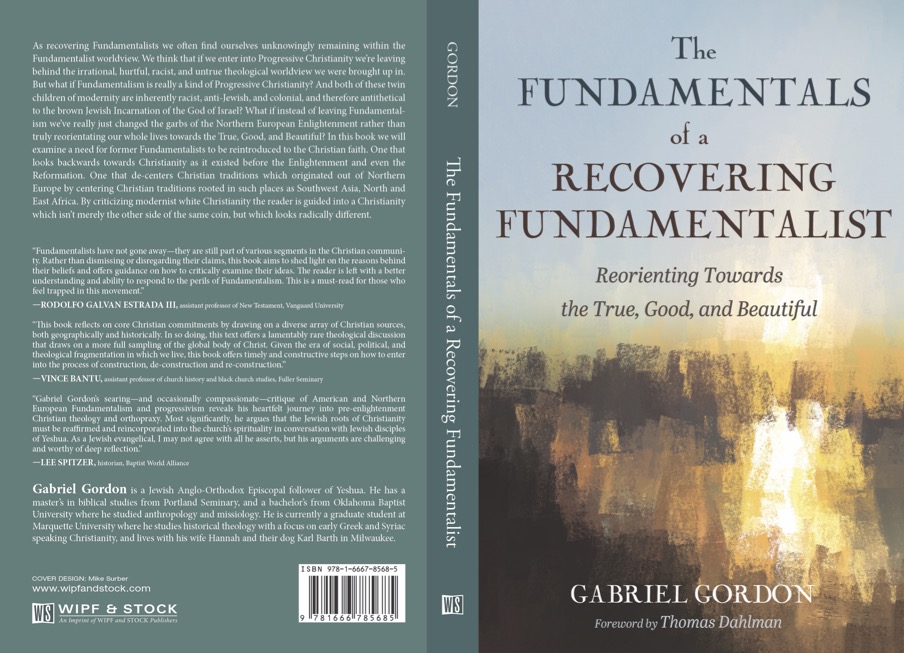
I had the honor of speaking with my friend and author Gabriel Gordon about the Gospel, gnosticism, & his new book The Fundamentals of a Recovering Fundamentalist. My questions are in bold.
What is the gnostic gospel and how prevalent is it in the American church? What is the gospel? What is the gospel not?
When many of us were growing up in fundamentalist Protestantism the gospel which was presented to us went something along the lines of: the world and your body are evil and will one day be destroyed by God. So, if you want to avoid the destruction of this world and the hell to follow then you need to intellectually assent to the propositional truths that only Christians know, namely that the Messiah came to die and rise from the dead to rescue us. If you believe these set of propositions, then when you die, your real self, namely your soul, will escape the physical world and your body and go live in a disembodied heaven for eternity. In the meantime, since your body and the material world are going to burn up anyway and it’s all evil we need to retreat from the world as much as possible and we thus have no reasonability to the stewardship of the environment. We will retreat from the world by making our own radio stations, starting our own coffee shops, homeschooling our kids, making our own movie industry and so forth. This is all essentially the old heresy of Gnosticism reiterated with certain modifications, but Gnostic nonetheless. In contrast to Judaism, the Gnostics taught that creation and the body are evil because they were created by an evil God, that the spiritual and ethereal is good over and against the physical, that they had a secret knowledge that no one else had, that if you believed with your mind in this secret knowledge, you would obtain salvation from the body and material world and live in a disembodied state of existence. And for many of us this was fairly prevalent in our fundamentalist Protestants upbringings.
In contrast to this Gnostic Gospel, Judaism and the early Church taught that the material world is good because it was created by a good God, and that included are bodies. That’s why the Torah [Law] has so many teachings about what you can and cannot put and do with the body, because Judaism is body-centric. The Torah even begins be describing God’s creation of all kinds of bodily things and declaring them good. The Torah espouses a way of life that holds the body and material world as sacred and as such must be honored. God is thus not going to destroy God’s creation or our bodies, but resurrect them! The afterlife, is in the renewed earth where all of creation lives embodied in harmony with every other part of creation. Yeshua’s life and ministry was a testimony to all of this rather than a “new” revelation, and he is the one who makes all of it possible, as the God of Israel who created it all and is bringing it all to its telos or completion. Which doesn’t mean its end, but its finished status so that it can live as God intended. The Incarnation, the life proclamation of the Kingdom of God (Israel’s being freed from its colonial oppressors) and its theosis of the whole world, the Cross (which was his defeat of death), the Resurrection (which is proof of his defeat of death as well as his proof that the colonial powers cannot defeat true power which is from the margins), and the Ascension (which is his completion of the sacrifice where he brings himself before the presence of God in the holy of holies, which was begun before the Cross and continued on it) all speak to the good news that God is restoring the world, putting it to rights, and actually finishing this garden project as it were, so that all of this creation can flourish in shalom harmony with God and others.
What moments led to your current understanding of the gospel?
Well, that’s a good question I’m not sure I have an answer too. There were I’m sure a lot of moments all piling up upon one another to get me to where I am today, which is on top of the shoulders of the Rabbis, Fathers and Mothers of the Church. My time in College at Oklahoma Baptist University of course had a lot to do with it, as well as my time at Portland Seminary. Really reading my own Jewish tradition, and the various parts of the Gentile Christian tradition had a lot to do with it. Engaging with the Syriac, Coptic, Armenian, Georgian, Ethiopian, Greek, Latin, Catholic, and Protestant traditions all aided in my bodily understanding of the gospel as it stands today. Although we are never complete, the yeast of God’s good news is always being kneaded throughout our dough, so to speak. The wine is never quite yet aged to completion, but somehow always is replenishing itself even as we drink from it gaining nourishment as we continue along in our journey of living the gospel in thought, word, and deed.
In your book you state that there is no salvation outside of Israel. Can you lay out what you mean?
Maybe another way to say it is that there is no salvation outside of Jewish flesh and blood. When the Word of God, the second person of the Trinity, the Lamb slain before the foundation of the world takes on human flesh, it is not generic human flesh he takes on but particular flesh and blood, namely the flesh of Israel. If we confess that in the Incarnation God is fully human, we have to say he’s Jewish. Because nobody who is human is lacking in ethnic particularity. Part of what it means to be truly and fully human is to be ethnically particular. Starting from this reality we began to realize that God’s promise to Abraham in Genesis 12, namely that the nations will be blessed [saved] through the seed of Israel, finds its eternal accomplishment in Yeshua the Jewish Messiah of Israel. God’s plan from the beginning as it were was to create a people for himself, namely Israel, so as to bring the world into salvation through this people. In a sense this Jewish salvation has been in front of us the whole time. Take the story of the Samaritan woman at the well as an example. When Yeshua encounters her, he says to her, “Salvation is from the Jews.” Note that he says is and not was. Salvation is still from the Jews, and because God has permanently taken on Jewish flesh in the Incarnation, Israel’s role as the world’s source of salvation is an on-going role which is permanent.
Later on, in the Gospel of John, Yeshua proclaims, “I am the Way, the Truth, and the Life, and no one comes to the Father except through me.” In others words, the Way, the Truth, and the Life is a Jew, and no one comes to the Father except through this Jew named Yeshua, through his Jewish flesh and blood. Through the Jewish Incarnation Israel is God’s chosen media for the world’s healing.
This Jewish salvation also has a Eucharistic element to it. For those of us who partake in the Eucharist every Sunday, a Eucharist we proclaim to somehow mysteriously be the blood and body of our Lord Yeshua, we find ourselves in the presence of the Medicine of Life (a phrase from Ephrem the Syrian for the Eucharist), a medicine that gives life to the world. If indeed we proclaim that this is his body and blood which gives life to the world, we are implicitly, even if unknowingly, announcing that each week we are sustained, brought life, and healing through the feasting on of Jewish flesh and blood. God who is Life itself, totally self-sufficient and lacking nothing in God’s own existence, paradoxically takes on Israel’s flesh as his own, and simultaneously takes into these newly formed veins the life blood of Israel in order to give himself life, so that he may live as a Jew. Our bloods not only runs through the veins of God, but gives him life, by carrying oxygen throughout his Jewish body. Then in the Eucharist the God-Jew offers this Jewish blood, which gives him life, to the whole world so as to bring healing and life.
In light of all this, the implication which bubbles to the surface is that anti-Jewish racism, because of the Incarnation, is anti-Theism. Those who hate Jewish flesh and blood hate God who saw fit to take on Jewish flesh and blood as his own, and thus hate their source of salvation. Given the history of such racism, the false teaching that God has rejected Israel in favor of the Church, and the exponential rise in anti-Jewish racism in the last few years and months, renewed emphasis should be given to the Jewish flavored reality of salvation. Indeed, there is a stream of theology in the Christian tradition which states that because there is no before or after in God, given that God is eternal and unbound by time, the flesh of the Son of God has always been. St Gregory of Sinai in the 14th century says it this way, “to know and profess that the single Son, both prior and subsequent to the Incarnation, is to be glorified in two natures, divine and human…” (Emphasis mine). Meaning that the Son of God’s two natures, human and divine, are somehow mysteriously eternal. Yeshua has always been God and a Jew. While there is a moment in time and history, in which God’s taking on of human flesh occurs, namely in first century Galilee and Judea, in God since there is no before or after, no time, this is always a reality in the Second person of the Trinity. Given what we said above about the humanity of Yeshua being Jewish it means that the Son of God has eternally been the God-Jew. The Jewish humanity of the Messiah is thus the eternal paradigm in God from which all of humanity is based and created from. He who is the image of God (Colossians 1:15) is the eternal God-Jew in whom all of humanity is created in. Through and through the fabric of reality we cannot escape this eternal mystery that there is no salvation outside of Israel.
For those who want to further study the gospel according to the Christian Scriptures, what advice or tips can you give, as well as any resources you would recommend?
Stay rooted in the Tradition. Frankly there is a lot of crap out there that can suck us in and cover us in sewage. And as one can imagine if you have any cuts or open wounds, being covered in sewage is going to lead to infection. A good rule of thumb is to stay away from German theology. For some reason it’s been producing vile material for a long time. Although of course, there are exceptions to this. Karl Barth (alright I know he was Swiss, but he spoke German), Barbara Meyer, and Dietrich Bonhoffer are a few exceptions to the rule that you should engage with. German beer is of course the best German theology you’ll get and it surely will be the redemption of the German people despite all their sins. Highly recommended drinking. There is also a lot of positive rich treasure to mine in the Christian Tradition. The Syriac tradition (which spread to India by 200 C.E., and to China by the 600s), the Ethiopian tradition, and the Greek traditions are all great resources the West is largely unaware of. Looking to Jewish Disciples of Yeshua (both Messianic Jews and Jewish Christians) is also a tremendous resource for those wishing to understand bodily the gospel according to the Scriptures. For more resources check out the recommended resources at the end of my book.
Thank you, Gabriel, for your time.
About Gabriel Gordon: Gabriel Gordon is an Indigenizing and Decolonizing Jewish Anglo-Orthodox Episcopalian follower of Yeshua. He has a master’s in biblical studies from Portland Seminary and a bachelor’s from Oklahoma Baptist University where he studied anthropology and missiology. He is currently a graduate student at Marquette University where he studies historical theology with a focus on early Greek and Syriac speaking Christianity. He lives with his wife, Hannah, and their dog, Karl Barth, in Milwaukee.


 Questions That Matter
Leave a comment