
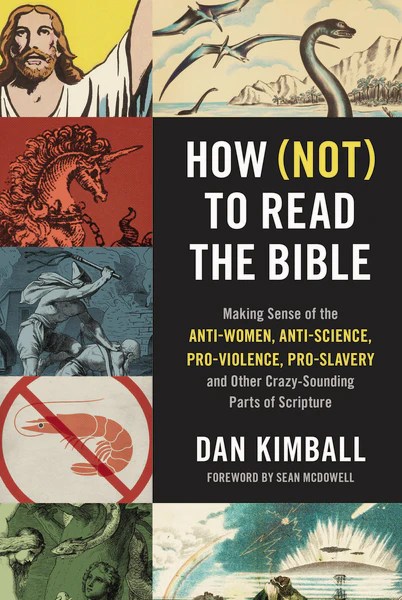
In our misinformation-driven age, whoever has the cleverest meme wins the argument. Gone it seems is our ability to think deeply, to communicate well, and to articulate well-thought-out positions. In this slippery cultural moment chalk-full of clickbait, many hunger for balance and nuance rather than mere edginess or emotionalism. To this end, author and pastor Dan Kimball has a witty resource dedicated to the complex world of the Bible: How (Not) to Read the Bible: Making Sense of the Anti-women, Anti-science, Pro-Violence, Pro-slavery, & Other Crazy Sounding Parts of Scripture.
With poise, Kimball takes us on a journey of busting common myths Christians have about the Bible, science, and more. Along the way he also interacts with arguments made by the New Atheist camp, a camp which includes voices like Richard Dawkins and Sam Harris. Kimball insists he’s grateful for their work: “their criticism… forces me to pause, think, and reexamine the Scriptures to be able to “give a reason for the hope that we have.” To Kimball, Christians should never shy away from criticism or from outsider perspectives. He argues that an openness to listen to modern objections has the potential to sharpen our faith.
How (Not) to Read the Bible attempts to make sense of the strange and bizarre aspects of Scripture, as well as its provocative nature. Naturally, many strange-sounding verses which offend our modern sensibilities will find themselves floating around the internet in the form of memes mocking Christianity. Throughout the book, Kimball includes quite a few of these popular memes and takes them on one by one, bringing in reputable scholars to interact with. Kimball’s argument is a basic one: there’s generally more than meets the eye in the Bible. It is after all an ancient collection of diverse writings, not a book written with our sensibilities in mind.
Kimball isn’t opposed to atheists (and other non-Christians) rejecting Christianity, he only hopes more and more of them will do so for valid reasons rather than because of an edgy meme.
The Bible is Not a Book
This may come to the surprise of many since Christians themselves will generally think of the Bible as a book. But rather than being one book, it happens to be an ancient collection of diverse writings—an old library in essence. This library contains many genres, various diverse authors with different personalities and viewpoints, all responding to (at least in part) various crises or pressures or situations of their day. Kimball helpfully pushes back against much of today’s black-and-white thinking, arguing that the Christian Scriptures can be quite nuanced. On certain issues the Bible is crystal clear while on others we must do some heavy-lifting.
The Bible was not Written to Us
Modern Western Christians can be guilty of assuming the Bible was written with our specific sensibilities in mind. In reality, it was written to ancient people in a way that they would be able to understand. It addressed their worries and concerns, trends of their time. If we have little-to-no understanding about the world of the Bible, we will never understand the many points the Bible makes. Simply put, we’re not ancient people. The world that birthed the Christian Scriptures happens to be a complex and strange world and Kimball invites the reader to step into this world and learn from it.
Cherry-Picking Bible Verses leads to Atheism
What about the parts of the Bible Christians may avoid? The bloody parts, the disturbing ones, the violent ones? Kimball pleads with Christians to stop skipping over these texts. Christians aren’t called to cherry-pick their way through God’s Word. It’s our responsibility to look at these texts and wrestle through them. Kimball is on to something when he suggests the reason many leave the faith is that they avoided these texts altogether. In learning to wrestle through difficult passages (hopefully in community), God’s people will be less likely to be shocked when someone else brings up these hard texts. To shy away from all hard texts is a disservice to Scripture as well as a possible hindrance to our own discipleship.
Who is this Book For?
As with Kimball’s other books, his pastoral and inviting tone helps the reader lay down their defenses. Kimball never tells the reader how to think. He makes suggestions and at times lays out various diverse viewpoints that Christians have along with their strengths and weaknesses.
Well-researched, thoughtful and accessible, I recommend this to anyone who wants to a) understand the Bible on its own terms or b) anyone who wants to discredit the Bible (in a responsible way). Those who reject Christianity may be pleasantly surprised with this book, the crux of Kimball’s argument being this: if someone is to disagree with the Bible, they ought to do so in an intellectually-honest way. Christians may find themselves pleasantly surprised as well as they learn to stop seeing the Bible through a Western lens. When we choose to become careful students of the Bible, we show reverence to its Author. This is not bibliolatry; this is the proper posture of disciples sitting at the feet of Jesus to learn from him. The Bible wasn’t written to address us directly and our modern fears (nuclear war, climate change, questions of A.I and life on planets). When we understand the questions of the original audience(s) of the Bible, we can then begin to move forward in applying Scripture to our own unique cultural moment.


 Questions That Matter
Leave a comment